Technical Notes
Ultrapure Water for Semiconductor Manufacturing
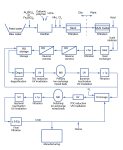
This technical note provides a basic familiarity with the design elements and functionalities for UPW systems. We will discuss the main UPW parameters, the treatment sequence for UPW and provide some details of the main treatment steps.
Technical Notes
Semiconductor Gas Storage and Delivery
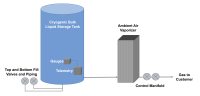
A variety of gases are employed for different purposes within a semiconductor device fabrication plant. These gases range from the pyrophoric and/or toxic specialty gases required for thin film deposition and doping processes through the reactive and corrosive gases needed in different etch processes.
Technical Notes
Semiconductor Fab Utilities Overview
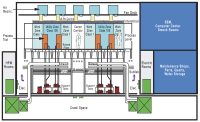
Semiconductor fabrication utilities include ultrapure water, bulk high purity gases such as nitrogen and argon, exhaust gas handling and disposal, and cleanroom air systems.
Technical Notes
Cleanroom Ultra-clean Air Delivery
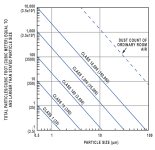
Semiconductor fab environments require ultra-clean conditions to ensure low numbers of product defects due to particulate contamination. A critical aspect in creating an ultra-clean environment is proper design of an air purification and handling system to deliver ultra-low particulate air to the work environment.
Technical Notes
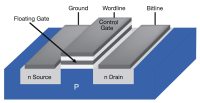
Flash Transistor Physics
Flash transistors are used in memory devices. Their design is similar to that of MOSFETs with the main design difference being that they employ two gates rather than one.
Technical Notes
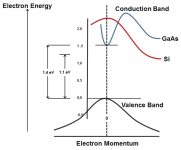
Compound Semiconductor Epitaxial Thin Films
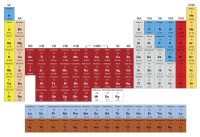
Compound semiconductors are materials such as GaAs, AlGaAs, GaN, CdSe, InP, InSb, etc. These materials combine the elements from equidistant columns on either side of Column IVA of the Periodic Table.
Technical Notes
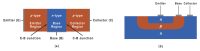
Bipolar Junction Transistor Physics
BJT operation involves both electrons and holes. It can be configured as either a PNP transistor or an NPN transistor which can be constructed as either a three-layer sandwich or as a planar device.
Technical Notes
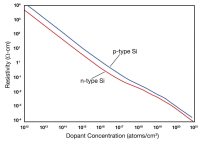
P-N Junction Physics
When p-type semiconductor and n-type semiconductor materials are placed in physical contact, the area around the contact (known as the junction) behaves differently than either of the two source materials.
Technical Notes
Electrical Characteristics of Solids
When it comes to electrical characteristics, solid matter falls into one of three categories: it is either a conductor, an insulator, or a semiconductor, depending on whether or how well it conducts electricity.
Technical Notes
FinFET Physics
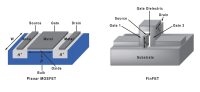
It can be seen that all of the familiar components of a MOS device are present in the FinFET (drain, source, gate, gate dielectric) and that the device more effectively separates the source and drain from the substrate silicon.

Technical Notes
Semiconductor Exhaust Gas Treatment
The process exhaust downstream from the cleaning, deposition and metal etch processes often experiences problems due to fouling often caused by the condensation and build-up of process by-products on the internal surfaces of vacuum components and exhaust lines.
Technical Notes
Chemical Vapor Deposition Physics
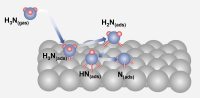
Chemical vapor deposition processes can be defined as: any process in which a thin solid film is formed on a substrate by the surface-mediated reaction of adsorbed precursors from the gas phase.
Technical Notes
Electrical Conduction in Solids
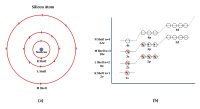
The physical mechanism of electrical conduction in solids is best understood using a model that physicists refer to as "band theory", which is based on the idea that the state of an electron in a solid is described by a four-fold scheme of quantum numbers.
Technical Notes
Diode Physics
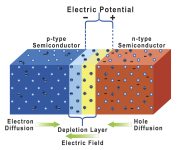
The characteristic response of a solid state diode to an external electrical potential or to an energy source such as light forms the basis for devices such as bipolar junction transistors, solar cells, LEDs, lasers and photodiodes.
Technical Notes
Polycrystalline Silicon Thin Films
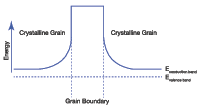
Polysilicon thin films are produced using a process known as chemical vapor deposition or CVD. Heavily doped polysilicon and poly-silicide films have been used as gate electrodes and interconnects in MOS devices.
Technical Notes
MOSFET Physics
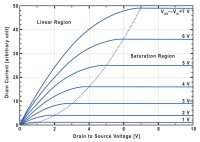
MOSFETs are planar surface devices that are the most commonly used variant of Field Effect Transistors (FETs);including Junction Gate Field Effect Transistors (JFETs) and Insulated Gate Field Effect Transistors (IGFETs).
Technical Notes
Metal Thin Films for Contacts and Interconnects
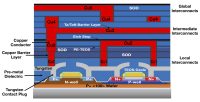
In semiconductor device fabrication, contacts are the metal components in direct contact with silicon in transistors and other devices, while interconnects are the current-carrying lines that connect discrete devices within an IC.
Technical Notes
Dielectric Thin Films
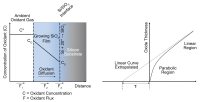
Thermal SiO2 films for device components can be formed in a variety of ways; the selection of method is dependent on such factors as substrate composition/topography and the thermal tolerances of other device features on the substrate.
Technical Notes
Electrical Conduction in Semiconductors
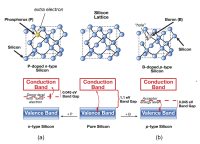
The electrical property that makes semiconducting materials so valuable in electronics applications arises from the fact that their electrical conductivity can be continuously varied.
Technical Notes
Silicon Based Epitaxial Thin Films
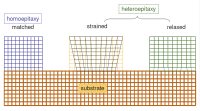
Epitaxy is defined as the "regularly oriented growth of one crystalline substance on another". Both homoepitaxy and heteroepitaxy processes are used in semiconductor device fabrication.